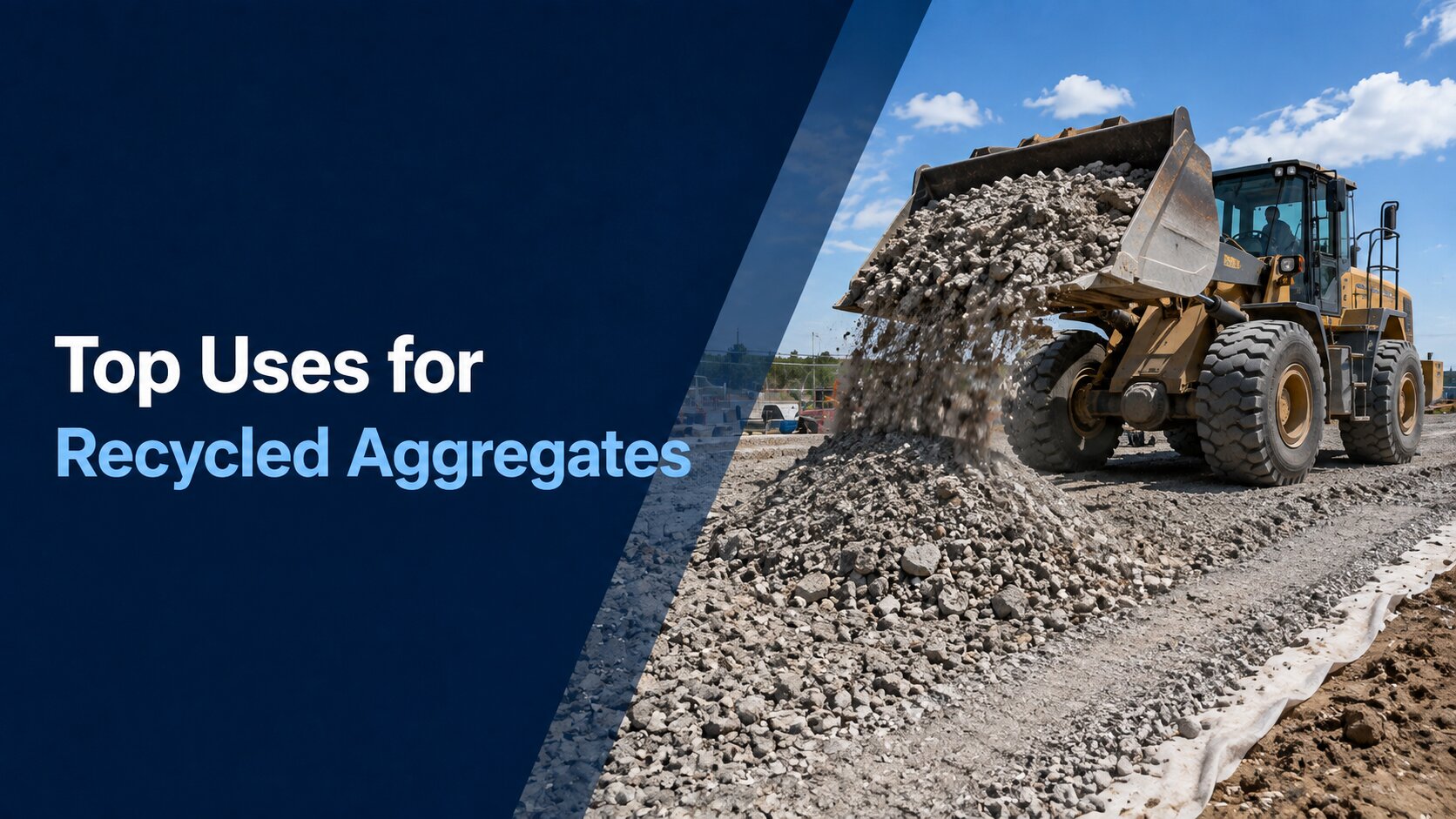

Recycled aggregates are crushed, screened construction and demolition materials—like concrete and hardcore—that replace quarried stone. Contractors love them because they’re cost-effective, widely available for bulk jobs, and align with sustainability targets, all while performing reliably as sub-base, backfill, capping and haul road material when the right grade is specified.
Picture the scene. You’re halfway through a groundworks job, the programme’s tight, the budget’s tighter, and there’s a growing mountain of muck that needs shifting before the next phase can start. On top of that, you need a stable base laid before the weather turns. It’s the kind of week that tests everyone on site.
This is exactly where recycled aggregates earn their keep. Used correctly, they’re the no-drama option that keeps a job moving without blowing the budget or the timeline. At Mason Trucking, we produce a range of recycled aggregates and soils, and we can deliver them straight to site by grab or haulage—often clearing your muck away in the same visit.
Here’s our honest, on-the-ground guide to the top uses for recycled aggregates, why so many contractors have made the switch, and how to pick the right material for the job.
What are recycled aggregates (and what construction waste are they made from)?
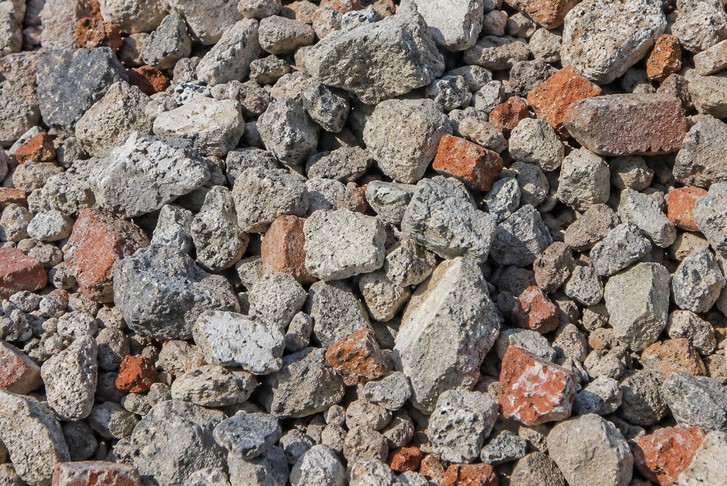
Recycled aggregates are materials recovered from construction waste, demolition waste and excavation work, then processed into reusable building products. Rather than sending rubble to landfill, it gets crushed, screened and cleaned of contaminants to create a genuine alternative to virgin quarried stone.
Common sources include:
- Demolished buildings (concrete, brick, mortar)
- Recycled hardcore from site clearance
- Crushed concrete from broken-out slabs and foundations
- Mixed arisings such as crushed concrete, brick and glass
Once processed, these materials become things like crushed concrete, recycled Type 1 sub-base, and bulk fill—all widely used across the UK construction sector, with these processed materials often reused in new projects for a range of construction applications. The key word here is processed. Well-screened material behaves predictably. Poorly processed stuff can hide bits of wood, plastic or plaster that cause headaches later.
And this isn’t some niche corner of the industry, either. Across the construction industry, demand for construction aggregates tells the same story. According to the Mineral Products Association, recycled and secondary aggregates in Britain hit a record 73.5 million tonnes in 2022, accounting for over 30% of the country’s total aggregate demand. That gives Britain the highest recycling rate of any major European economy—so if you’ve been thinking of recycled material as the fringe option, the numbers tell a rather different story.
At Mason Trucking, we run a recycling plant approved by the Environment Agency for soil and hardcore, so the material we supply is handled properly from the start. If you’re not sure what grade you need, give us a shout—we’re happy to point you in the right direction.
Why contractors love recycled aggregates for cost savings
The switch from primary to recycled aggregates isn’t about cutting corners. It’s about smart choices. Here’s why they’ve become the go-to for so many construction projects and construction work:
- Cost control. Recycled aggregates typically cost less than virgin quarried stone, helping cut overall costs; on bulk fill or large groundwork jobs, that difference adds up fast, and some reports suggest cost savings of up to 32% on construction costs in the right conditions.
- Sustainability targets. Using recycled aggregates helps reduce landfill waste, conserve natural resources and support wider environmental goals, while also backing the circular economy.
- Availability for bulk jobs. When you need serious volume in a hurry, recycled material is often easier to get hold of than waiting on quarried stock.
- Reliable performance. For sub-base and fill applications, quality recycled aggregate compacts brilliantly and holds its shape under load.
- Site efficiency. Bring material in and take muck away in one flow, and using recycled aggregates can lower carbon emissions from sourcing and transport. This also makes it easier to keep recycled materials moving through construction activity without slowing the job down.
Top uses for recycled aggregates
Not every aggregate suits every job. Here’s where recycled material genuinely shines—along with a few watch-outs.
Sub-base for roads, driveways and car parks
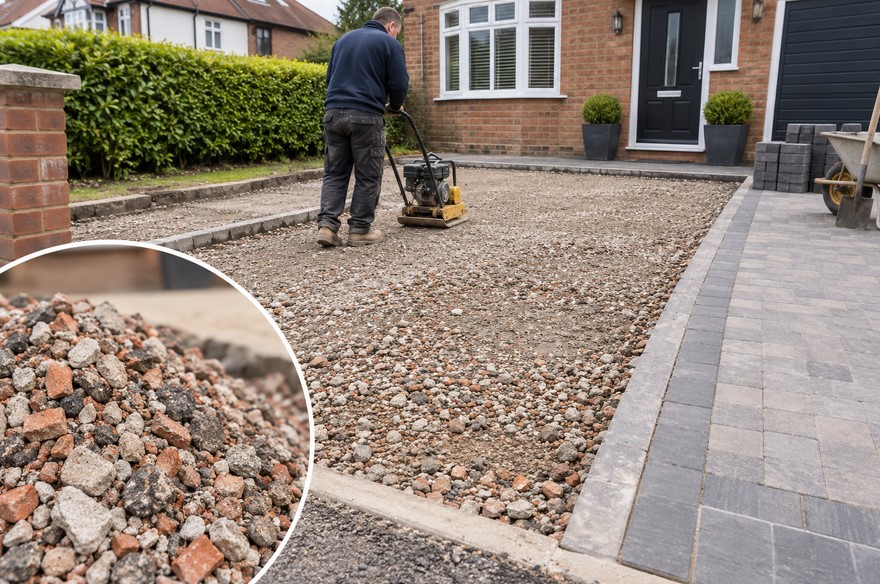
This is the classic use case. Type 1 recycled sub-base, made from crushed concrete, is a direct replacement for MOT Type 1 under roads, driveways, patios and car parks. It locks together beautifully under compaction, creating a firm, stable platform.
Quick tip: Lay it in layers and compact each one properly. Skimp on the compaction and you’ll pay for it later with settlement and cracking.
Backfill for trenches and foundations
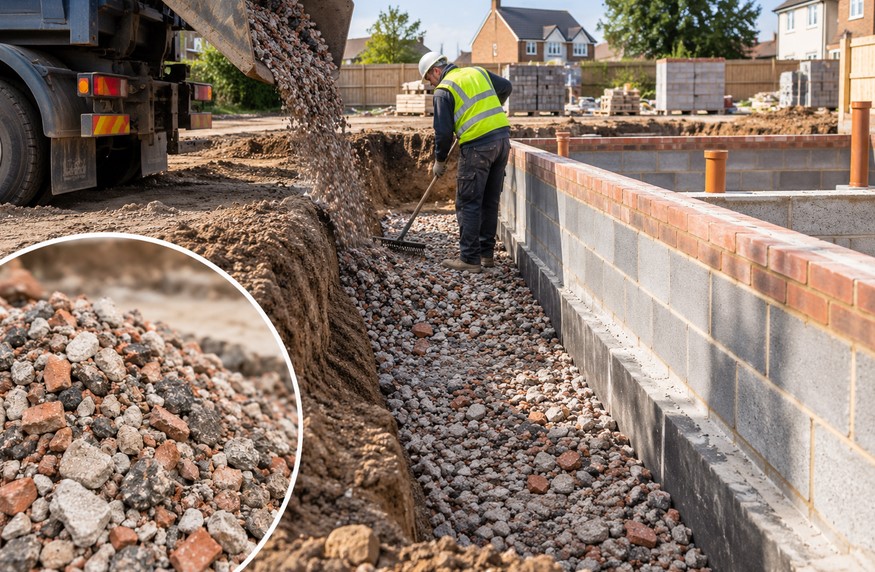
Recycled aggregates make excellent backfill—provided the spec allows it. They’re ideal for raising levels and filling voids economically.
Watch-out: Keep oversized material away from services and pipes, and compact in layers. Backfill suitability always depends on the specification and any drainage requirements, so check before you order.
Capping layers and formation improvements
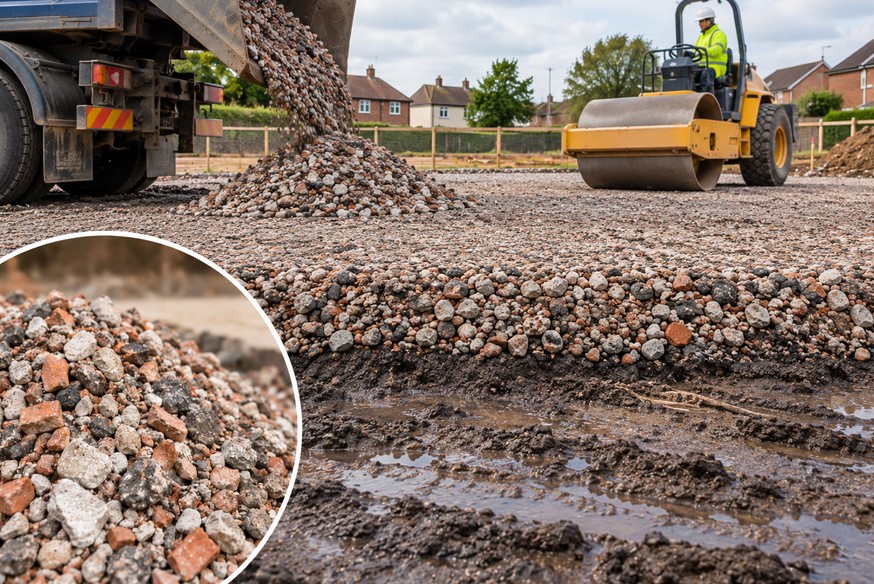
When you’re working over poor ground, a capping layer creates a stable working platform to build off. Coarser recycled material (like 6F2 or 6F5 crushed concrete) is perfect here—it’s built for heavy-duty fill rather than fine finishing.
Get your formation right and the whole programme benefits, because everything above it goes down quicker and holds better.
Temporary haul roads and site access tracks
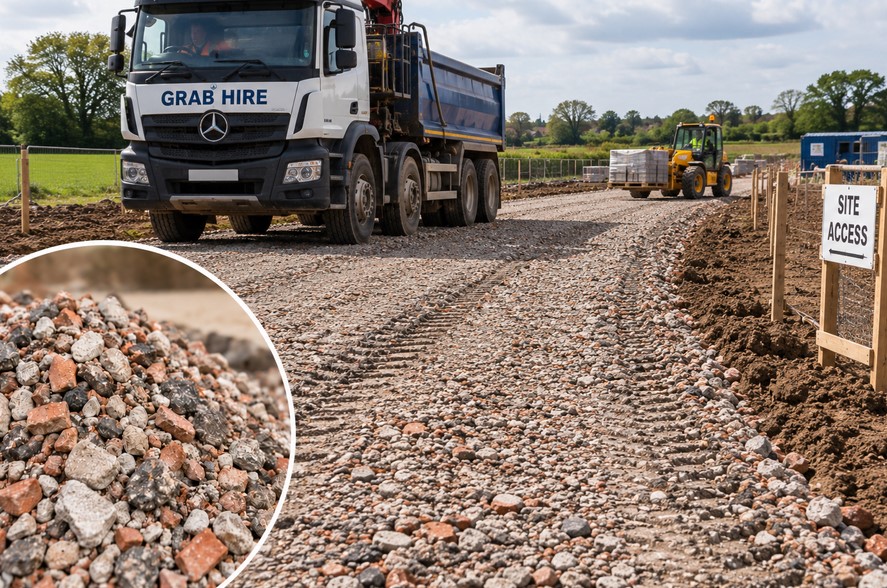
Keep the wagons moving and the mud where it belongs. Recycled aggregates are ideal for temporary haul roads and access tracks that need to take real punishment without costing the earth.
Need it delivered where a tipper won’t fit? Our grab lorries can reach awkward spots and drop material exactly where you need it.
Piling mats and crane pads
Recycled aggregates can form part of a properly engineered piling mat or crane pad build-up. The emphasis is on properly engineered—these are load-critical applications that need design input and the correct specification. Used as part of a well-designed build-up, recycled material does the job.
Landscaping projects, patios and paths
It’s not all civils and heavy plant. Recycled aggregates work a treat for landscaping sub-bases, garden path foundations and patio bases. For smaller contractors and domestic projects, they’re an affordable, practical choice—and our grab lorries make delivery to tight-access sites much simpler.
Drainage layers and soakaway surrounds
Some recycled products—like crushed brick—drain well thanks to their porosity, making them useful around soakaways. But here’s the catch: not all recycled material is free-draining. Crushed concrete and certain mixed aggregates hold water. If drainage matters, tell us what you’re working with and we’ll match the material to the application.
Recycled and secondary aggregates vs primary aggregates: the real difference on site
Short answer: Recycled aggregates win on cost and carbon, while virgin aggregates and virgin materials offer more consistency for precision or structural work. For the majority of groundwork layers—sub-base, fill and capping—recycled material performs just as well at a lower price. For more, check our blog.
Both have their place. The honest comparison comes down to cost, carbon and consistency.
| Application | Recycled aggregate suitability | Notes |
| Sub-base (roads, drives, patios) | Excellent | Type 1 recycled performs like MOT Type 1 |
| Bulk fill / ground raising | Excellent | Great value; mixed aggregate works well |
| Capping layers | Excellent | 6F2/6F5 built for heavy-duty fill |
| Trench backfill | Good | Depends on spec and drainage |
| Drainage / soakaways | Varies | Use free-draining material only |
| High-grade concrete mixes | Limited | Usually needs primary aggregate |
As a rule of thumb: recycled aggregate is better suited to bulk groundwork layers where value and volume matter, while primary aggregate works best when you need tight consistency for structural concrete or precision finishing. Recycled aggregates carry a lower embodied carbon footprint and a lower price tag; primary aggregates offer that extra uniformity. Using recycled aggregates also reduces landfill waste and conserves natural resources. For the vast majority of groundwork layers, recycled material more than holds its own.
Worth knowing: the WRAP Quality Protocol, developed by the Environment Agency and the Waste & Resources Action Programme (WRAP), sets out how recycled aggregates achieve “End of Waste” status from inert waste and meet recognised standards. In practice, the material is collected, sorted, inspected, crushed and screened, then quality-checked before it can legally be sold as a fully recovered product rather than waste; for example, that can include removing contaminants and verifying grading before dispatch. Alongside this, recycled aggregates are tested against British Standards such as BS EN 13242, which covers unbound mixtures used in sub-bases. Together, these give contractors and clients confidence the material is fit for purpose.
How to choose the right recycled aggregate
A quick checklist to save you a headache:
- What’s it for? Sub-base, bulk fill, drainage or landscaping—each needs a different material.
- What grading or spec is required? Match the product to the job, not just the price.
- How’s the quality controlled? A reputable supplier screens and grades material to strict standards.
- How will it be delivered? Grab, tipper or hiab depending on your access and volumes.
- What about timing? Order to suit your programme so nothing sits around getting in the way.
Got a tricky site or tight access? Tell us what you’re working with and we’ll advise on the best approach.
Common mistakes we see (and how to avoid them)
- Ordering the wrong grade. The cheapest option isn’t always right for the final layer. Cap bulk fill with Type 1 for the finished surface.
- Poor compaction. Rushing this, especially in wet weather, undoes all the good work.
- Assuming “recycled” means “free-draining.” It often doesn’t. Check before you rely on it for drainage.
- Skipping the paperwork. If you’re tipping, sort out the rules and waste documentation in advance.
How we can help at Mason Trucking
We’re a family-run business with 14 years under our belt, based at Marks Tey near Colchester—handy for the A12 (Junction 25) and the A120, with good knowledge of London and the eastern counties.
Here’s what we bring to your project:
- Recycled aggregates and soils produced at our Environment Agency–approved recycling plant.
- Grab hire for muck away, site clearance and aggregate delivery in one efficient flow.
- Hiab haulage with crane-assisted lifting up to 5 tonne.
- Fully insured vehicles, with goods in transit insurance up to £100,000.
- Polite, certified operators and drivers who know how to work on a live site.
We cover Essex and the surrounding areas, including Basildon, Billericay, Chelmsford, Clacton, Colchester, Ipswich, Sudbury and Suffolk, and our trading hours are Monday to Friday 7am–5pm and Saturday 8am–1pm.
We also offer a free tip for hardcore and concrete, though you’ll need to contact us first for the rules. Topsoil, or topsoil mixed with hardcore, can be tipped at a charge—but again, please get in touch beforehand, as we’re limited on what we can take in, and a waste carrier’s licence is required.
Frequently asked questions
What are recycled aggregates used for?
They’re used in construction applications for sub-bases under roads, driveways and patios, bulk fill and ground raising, capping layers, trench backfill, temporary haul roads, landscaping bases and some drainage applications. The right product depends on the job.
Are recycled aggregates suitable for driveways?
Yes. Type 1 recycled sub-base, made from crushed concrete, is commonly used under tarmac, gravel and block paving driveways. Just make sure it’s compacted properly and capped with a suitable top layer.
Are recycled aggregates cheaper than primary aggregates in the UK?
Generally, yes. They usually cost less than virgin quarried stone, and the saving can be significant on bulk jobs. Just remember that value comes from using the right material for the right layer.
Do recycled aggregates meet building specifications?
Quality recycled aggregates that meet recognised British and European Standards—and achieve End of Waste status under the WRAP Quality Protocol—perform to the same standard as primary aggregates in the correct application, including compliant construction industry settings. Always confirm the spec for your job.
What’s the difference between recycled hardcore and Type 1?
Recycled hardcore is a general fill material and can vary in size and consistency. Type 1 recycled sub-base is screened and graded to a specific standard, making it suitable as a load-bearing sub-base under surfaces.
Can I use recycled aggregates for drainage or soakaways?
Sometimes. Porous materials like crushed brick drain well, but crushed concrete and mixed aggregates often don’t. Speak to us so we can match a free-draining product to your drainage needs.
How much recycled aggregate do I need for a sub-base?
As a rough guide, one tonne of Type 1 recycled sub-base covers roughly 10 square metres at 50mm depth, though most driveways and roads need a compacted depth of 100–150mm or more. Multiply your area by your target depth to estimate the volume, then tell us the dimensions and we’ll help you work out the tonnage before you order.
Are recycled aggregates as strong as primary aggregates?
For sub-base, fill and capping applications, quality recycled aggregate performs just as well as primary stone once it’s compacted correctly and can provide durability in the correct application. For high-grade structural concrete or precision work, primary aggregate is usually still the better choice—it really depends on the application and specification.
Do I need a waste carrier’s licence to tip hardcore or soil?
For our tipping facility, yes—a waste carrier’s licence is required, and you’ll need to contact us first as we’re limited on what we can accept.
Get the right material to site, without the guesswork
Recycled aggregates aren’t second best anymore. Used correctly, they’re a cost-smart, sustainable and genuinely reliable choice for everything from sub-bases to haul roads. The trick is specifying the right grade for the job and working with a supplier who knows their stuff.
That’s where we come in. Whether you need aggregate supplied, muck cleared away, or a hiab to handle the heavy lifting, we’ll help you sort a plan that suits your site and your schedule.
Give us a call or drop us an email.