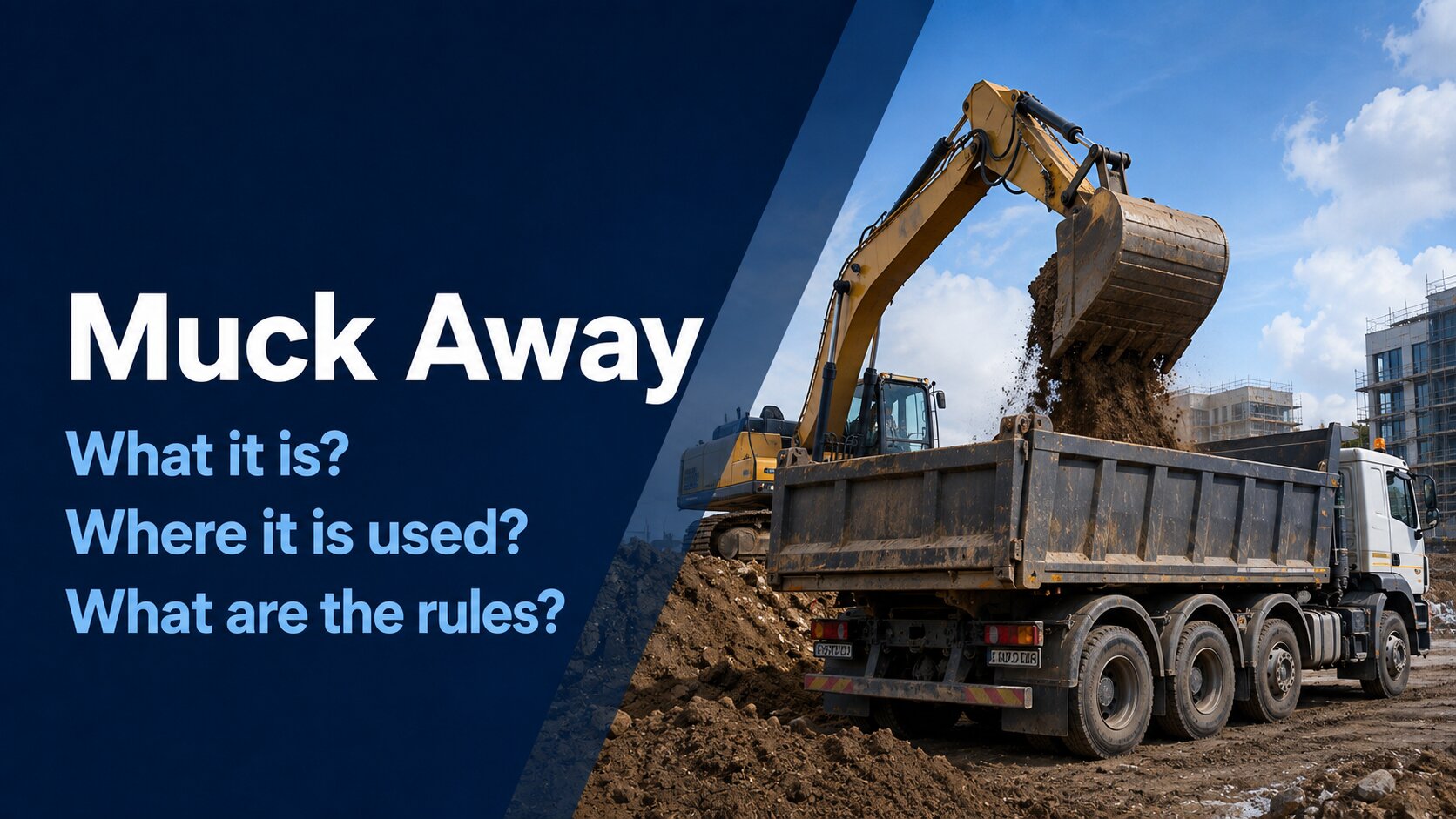

Muck away is the process of removing excavated soil, rubble and construction spoil from a site and taking it to a licensed facility for disposal or recycling. In the UK, it’s legally regulated—you need a licensed waste carrier, a waste transfer note, and to know what you’re actually putting on that lorry.
At a glance:
- Muck away covers soil, subsoil, hardcore, concrete and similar excavated materials
- All muck away in the UK must follow waste duty of care rules under the Environmental Protection Act 1990
- A waste transfer note is required for every collection
- Grab lorries are usually faster, cheaper and more flexible than skips for bulk spoil
- Inert materials like clean hardcore and concrete can often be recycled—sometimes for free
Digging up your garden? Laying new foundations? Clearing a site after demolition? At some point, you’re going to have a sizeable pile of soil, rubble or spoil that needs to go somewhere. That’s where muck away comes in. It sounds straightforward—and largely it is—but there are rules, waste classifications and paperwork that matter more than most people realise.
This guide covers everything you need to know: what muck away actually involves, what can and can’t go on a load, the legal requirements that apply in the UK, how disposal and recycling work, and how to get the job done smoothly. We’ll also touch on grab lorry muck away versus skips, what affects cost, and how to get your site ready for collection.
What “muck away” means in the UK
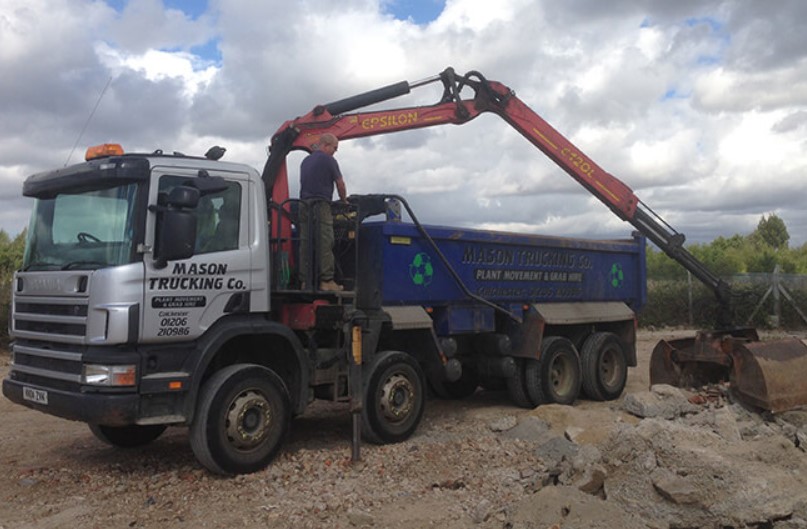
Muck away is, at its most basic, the removal of excavated material from a building or groundworks project. Think of all the soil shifted when someone digs footings for a house extension, or the broken concrete and hardcore from a driveway replacement, or the subsoil from a landscaping job that needs levelling out.
That material—generically called “spoil”—can’t just sit in a pile on your drive indefinitely. It needs to go somewhere appropriate, transported by someone licensed to carry it. That’s the muck away service: collection, transport and compliant disposal or recycling of your excavated waste.
Typical sources include:
- House foundations and extensions
- Driveway and patio installations
- Garden landscaping and levelling
- Utility trench excavations
- Demolition preparation and site clearances
What can be taken in a muck away load (and what can’t)
Not everything that comes out of the ground can go straight on a grab lorry—and knowing this upfront saves everyone a headache.
Generally acceptable materials:
- Clean topsoil and subsoil
- Hardcore (broken concrete, bricks, rubble)
- Sand and gravel
- Concrete and flagstones
- Clay and natural rock
Materials that cause problems:
- Mixed waste (soil mixed with plastic, timber or general rubbish)
- Plasterboard—this is classed as hazardous if landfilled with biodegradable waste
- Asbestos-containing materials (these require specialist disposal)
- Contaminated soil (petrol, oils, chemicals, heavy metals)
- Tyres, batteries, paint or chemicals
- Japanese knotweed (requires a licensed, permitted disposal facility)
The key thing with contamination is that it’s not always visible. Soil from old industrial land or former petrol stations may look perfectly clean but carry chemical contamination that changes how it must be handled and where it can go. If you’re not sure about your material, it’s worth having a conversation before the lorry turns up—getting it wrong means delays, extra costs and potentially legal liability.
If you want to double-check what your spoil counts as, we’re happy to talk it through before we book anything in.
Muck away rules in the UK (the bits you can’t ignore)
This is where people sometimes switch off—but bear with us, because getting this wrong has real consequences.
Waste duty of care
Under Section 34 of the Environmental Protection Act 1990, anyone who produces, carries, or disposes of controlled waste has a legal duty of care. This isn’t optional. It applies whether you’re a homeowner, a builder or a site manager. In plain terms, it means you’re responsible for making sure your waste is handled correctly—from the moment it leaves your site to wherever it ends up.
Breach of the duty of care is a criminal offence. Magistrates can issue unlimited fines on conviction. This is why using a legitimate, licensed contractor matters.
Waste carrier licence
Anyone transporting waste commercially in the UK must be registered as a waste carrier with the Environment Agency. You can—and should—check this on the EA’s public register before handing your waste to anyone. If a carrier without a licence takes your spoil and fly-tips it, you can be held partially liable. Ignorance isn’t a defence.
We’re a fully registered waste carrier, so you’re covered from the moment we arrive on site.
Waste transfer notes
Every time non-hazardous waste leaves a site, a Waste Transfer Note (WTN) must be completed and signed by both parties. It needs to include a description of the waste, the European Waste Catalogue (EWC) code, quantities, date and location of transfer, and the carrier’s registration details.
WTNs must be kept for a minimum of two years. If an enforcement officer asks to see them and you can’t produce them, that’s an offence in itself.
For hazardous waste (think contaminated soil, asbestos), the requirements go further—consignment notes replace WTNs, and records must be kept for three years.
How muck away disposal works (from site to sorting or recycling)
Here’s the typical journey your spoil takes once it leaves your site:
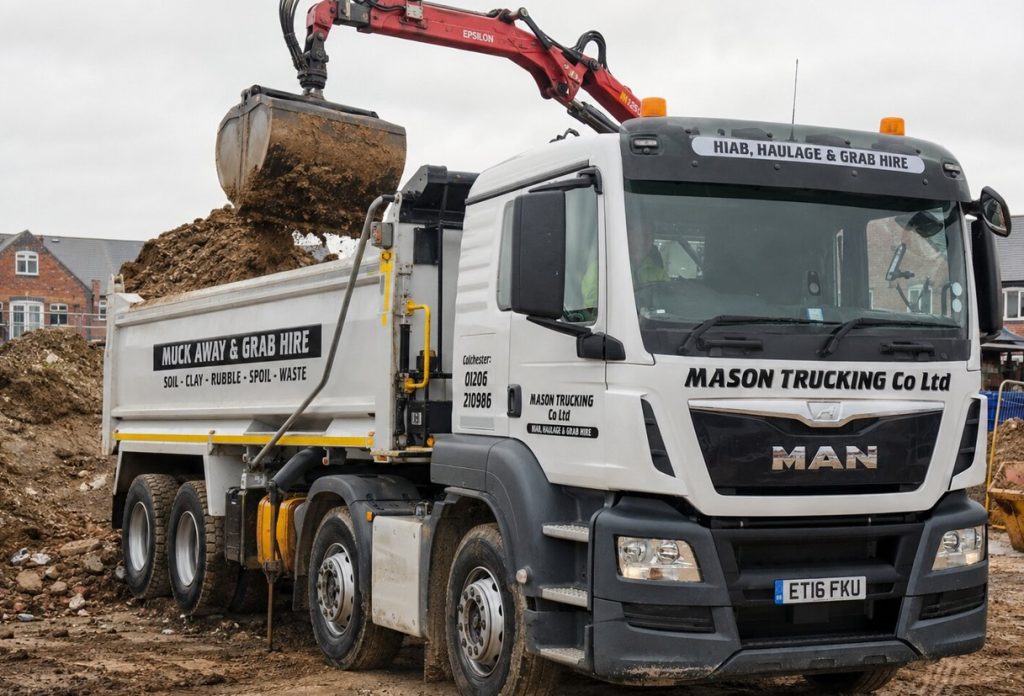
- Collection – Our grab lorry arrives, loads the material using the hydraulic arm, and the waste transfer note is completed on the spot
- Transport – The load is taken to a permitted facility—either a licensed landfill or a recycling plant
- Processing – Clean inert material can often be recycled and reused as aggregate or soil
- Records – Documentation is retained by both parties in line with legal requirements
On the recycling side, we operate an Environment Agency–approved recycling plant for soil and hardcore at our site in Marks Tey. Clean hardcore and concrete can be tipped free of charge—which is particularly useful for builders and contractors clearing significant volumes of inert material.
Topsoil, or topsoil mixed with hardcore, may also be accepted at a charge—but please contact us before you bring anything in, as we have limited capacity for those materials and need to check suitability first. It’s a quick call that saves everyone time.
Grab lorry muck away vs skips: what’s best for your job?
This is one of the questions we get asked most often, and the honest answer is: it depends on the job.
When a grab lorry makes more sense
Grab lorry muck away tends to be the better option for most bulk spoil removal jobs. Here’s why:
- Speed – A grab lorry can typically load and clear a site in under 30 minutes. No waiting around for someone to fill a skip over several days
- Capacity – An 8-wheel grab lorry can carry up to 16 tonnes of material—the equivalent of roughly three builders’ skips—in a single trip
- Access – The hydraulic arm can reach up to 7.6 metres, meaning it can lift material over fences, walls or obstacles without manual handling
- No permit required – Unlike a skip left on a public road, a grab lorry loads and leaves in one visit, so there’s no need for a highway permit
When a skip might suit better
Skips still have their place. If you’re generating waste gradually over a period of days or weeks—say, during a phased renovation—having a static container on site to fill at your own pace can be more practical. They’re also useful for smaller, lighter loads of mixed domestic waste.
Access considerations for grab lorry hire
For a grab lorry to operate safely, it needs at least 3 metres of width to manoeuvre and around 6 metres of height clearance for the arm. Overhead cables and low-hanging trees are the most common access issues—worth checking before you book. Our team will always discuss access when you call, so nothing comes as a surprise on the day.
What affects muck away cost in the UK
Muck away pricing isn’t one-size-fits-all. The main variables are:
- Volume and tonnage – More material means more loads and more cost
- Waste classification – Inert material is cheaper to dispose of than non-hazardous or contaminated soil, which may need testing and specialist facilities
- Access – Tight sites or difficult loading positions add time and complexity
- Distance to disposal facility – Longer haul means higher cost
- Contamination risk – If testing is needed before disposal, that adds to the timeline and overall price
- Whether materials are separated – Mixed loads are harder (and more expensive) to process than separated, clean material
Getting an accurate quote: Tell us roughly how much you’ve got (in tonnes or cubic metres), what the material is, where it came from, and what access is like. A couple of photos of the pile and the site entrance go a long way. We’ll come back to you quickly with a no-obligation figure.
How to prepare your site for a smooth muck away collection
A bit of prep on your end makes the whole job faster and avoids nasty surprises.
- Pile your material together in one accessible spot, away from overhanging cables or trees where possible
- Keep different materials separate—clean soil separate from hardcore, for example—as mixed loads may cost more to process
- Check access routes for width and height before booking
- Flag anything unusual in advance: buried pipework, suspected contamination, Japanese knotweed, anything that might change how the material needs to be handled
- Keep people clear of the loading area when the grab arm is operating—it’s heavy kit and safety matters
Why using a professional muck away service is worth it
Beyond compliance, there’s a practical argument for using a professional service: it’s faster, safer and leaves you with documentation that proves you’ve done things properly. That matters if you’re a contractor on a managed site, or a developer with a build control process to satisfy.
We’ve been running grab and muck away services for 14 years, out of our base near Colchester in Essex. Our drivers and operators are fully certified, our vehicles are properly insured—goods in transit up to £100,000—and we know the roads and sites across London and the eastern counties well. You won’t get a rogue operator or a vague paper trail with us.
FAQ
What does muck away mean in the UK?
Muck away refers to the removal and disposal of excavated material—typically soil, subsoil, hardcore or rubble—from a construction or landscaping site. It’s carried out by licensed waste carriers and must comply with UK waste duty of care legislation.
Is soil classed as waste in the UK?
Yes. Excavated soil is classified as controlled waste under the Environmental Protection Act 1990. This means it must be transported by a registered waste carrier and taken to a permitted facility unless it’s being reused on the same site under specific conditions.
Do I need a waste transfer note for muck away?
Yes. A Waste Transfer Note must be completed every time non-hazardous waste—including soil and hardcore—is collected and moved. Both the waste producer and the carrier must sign it, and copies need to be kept for at least two years.
Can a grab lorry take mixed waste?
It depends on the operator’s licence and the facility they’re taking it to. Inert grab lorry loads (soil, concrete, hardcore) are the norm. Some operators can handle certain general waste, but hazardous materials—asbestos, paint, chemicals, batteries—cannot go on a grab lorry under any circumstances. If you’re unsure, give us a shout before you load anything questionable.
What’s the difference between inert and non-hazardous waste?
Inert waste (e.g. clean soil, concrete, bricks) won’t react chemically or biologically with the environment. Non-hazardous waste has low levels of contamination that need monitoring but aren’t immediately harmful. Hazardous waste—asbestos, heavy metals, certain chemicals—requires specialist handling, consignment notes, and permitted disposal routes.
Can you take concrete and hardcore for free tipping?
Yes. We offer a free tip for clean concrete and hardcore at our Marks Tey recycling plant. Topsoil or mixed material may be accepted at a charge, but please contact us before you bring anything in, as we need to check availability first.
How much space does a grab lorry need?
At a minimum, 3 metres of width for the vehicle and around 6 metres of height clearance for the hydraulic arm. Our team will always run through access with you when you enquire.
Do I need a permit if the lorry loads from the road?
Not for a grab lorry. Because it loads and leaves in a single visit, there’s no need to apply for a highway permit—unlike a skip left on a public road, which does require one.
How quickly can muck away be arranged?
It varies depending on volume and scheduling, but we aim to turn jobs around quickly. Get in touch with your details and we’ll give you a realistic timeframe.
What information do you need for an accurate muck away quote?
Roughly how much material you have (tonnes or cubic metres), what type of material it is, where it came from, and what the site access is like. Photos of the pile and the site entrance are always helpful. From there, we can usually come back with a quote pretty quickly.
Ready to clear the site? Get in touch with us
Whether you’ve got a garden full of clay, a driveway dig-out to shift, or a commercial site clearance to manage, we can help. We offer no-obligation quotes and straightforward advice—just get in touch and tell us what you’re dealing with.
We’re based in Marks Tey near Colchester, covering Essex, London and the eastern counties.